


Ireland now has in place the strongest climate action programme the country has ever seen, including a commitment to increase the share of renewable electricity to up to 80% by 2030. This will involve a transformation of Ireland’s grid infrastructure and require an energy transition which empowers citizens and supports open, equal and meaningful community participation.
However, while there is general agreement that action on climate change is essential and the climate movement is growing in Ireland, there is relatively little agreement or understanding on what that actually means for people. There is also a lack of debate in the media around possible choices and impacts of those choices. This is particularly true regarding energy and energy infrastructure.
Recognisant of this, in late 2021, RGI and its two Irish Members, Friends of the Earth and EirGrid, have launched a new collaborative project, ‘Our Energy Future’. The core activity of the project will be to initiative inclusive discussions and reflections with communities, civil society organisations, local groups, and other stakeholders.
Project goals
Over 3 years, the project supported diverse, open dialogues on the challenges and opportunities associated with Ireland’s energy transformation, from development of grid infrastructure, to the need for a decarbonised, secure and affordable electricity, with a much higher share of community participation. More concretely, this entails:
01
Engaging with organisations and the public about what the energy transition means and how it may impact Ireland and their locality
02
Raising awareness and building capacity on the importance and development of community participation, including any roadblocks. This will also include building capacity on the important role of necessary electricity grid infrastructure as enablers of Ireland’s energy transition.
03
Identifying actors who have an interest in a more continuous exchange with Friends of the Earth and amongst themselves, facilitated by Friends of the Earth.
04
Engaging with issues regarding the strategic planning of energy infrastructure in order to promote development which does not result in adverse climate or environmental impacts.
05
Engaging with the Irish Government on establishing climate action as part of a structured social dialogue processes and promoting the proper consideration of energy and energy infrastructure.
06
Examining and engaging with relevant energy policy processes.
Project implementation
In 2022, Friends of the Earth (FoE) began reaching out to actors across Ireland to involve them in discussions and kicked off a series of engagement events:
- In June 2022, FoE gathered 20 groups from across Ireland in a workshop to ask “How can Ireland deliver a pro-active and inclusive response to the energy price crisis while supporting communities in the energy transition?”. Participants explored the impacts of increasing energy costs, as well as barriers and opportunities for households and communities to engage in the energy transition. Read more and see event documentation here.
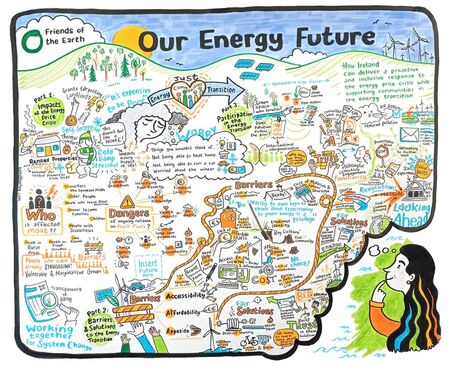
- In June 2022, FoE gathered 20 groups from across Ireland in a workshop to ask “How can Ireland deliver a pro-active and inclusive response to the energy price crisis while supporting communities in the energy transition?”. Participants explored the impacts of increasing energy costs, as well as barriers and opportunities for households and communities to engage in the energy transition. Read more and see event documentation here.
- In October 2022, another workshop asked “How can Ireland better protect the environment and biodiversity while ensuring necessary infrastructure to meet climate and renewables targets?”. Participants discussed issues relating to environmental impacts of renewables, changes to the planning system, as well as the impact of offshore wind on Marine Protected Areas, and civil society participants got the opportunity to engage with state and industry stakeholders on these issues. Read more here.
- In May 2023, the discussion on the environmental impacts of renewable energy was taken to the next level, as experts from civil society, solar and wind associations, and grid operators gathered for the workshop“How to improve national and local responses to biodiversity protection and environmental assessment while meeting renewables targets“.
- In November 2023, stakeholders from across Irish civil society and renewables-grid industry gathered again to deepen their discussions on 1) Environmental compliance and Renewables & Grid Rollout, 2) Data Standardisation and Accessibiility, 3) Community Involvement & Public Engagement, 4) Planning Compliance & Reform, and 5) Investment in Environmental Capacity. See more on the project website here.
- Throughout 2024, key stakeholders from an ‘Energy Vision Group’ of stakeholders from the renewables industry and civil society continued discussions and meetings, to work towards a shared vision and action points for achieving Ireland’s energy transition in the most sustainable, rapid way possible.
- In June 2025, the project announced the publication of a joint Declaration between Wind Energy Ireland, Solar Ireland and Ireland’s leading environmental network, the ‘Environmental Pillar’, which sets out a number of important, targeted measures to ensure that a zero-carbon electricity system which respects biodiversity is build as quickly and sustainably as possible.
About the project
This project was set up under the framework of RGI’s ‘IRD’ (Implementing RGI Declarations) projects. These are national level collaborations between TSOs and NGOs, which are based on the principles of the European Grid Declarations on Transparency and Public Participation and on Electricity Network Development and Nature Conservation.

contact
Stephanie Bätjer
stephanie[at]renewables-grid.euDirector – Communication

Stephanie Bätjer
stephanie[at]renewables-grid.euDirector – Communication

‘Our Energy Future’ is partially funded by the Mercator Foundation (Stiftung Mercator), as part of a project consortium which also involves public engagement projects of German Environmental Aid (DUH) and Potsdam Institute for Climate Impact Research (PIK).