

 19 December 2019
 Online
What advantages will high shares of renewables-based electrification bring for society, the climate and the economy? Saul Griffith, founder and chief scientist at Otherlab shares his thought-provoking ideas on modelling, efficiency, old narratives and the grid.
Otherlab – a US-based research and development firm – focusses on renewable and clean energy, robotics, automation, digital fabrication, adaptive textiles, advanced manufacturing, computational design tools and more. In 2017, they were charged with modelling an ultra-high resolution picture of the US energy economy. The results showed that “electrifying the US economy from carbon-free sources will reduce the amount of energy needed by more than half.” (read more).
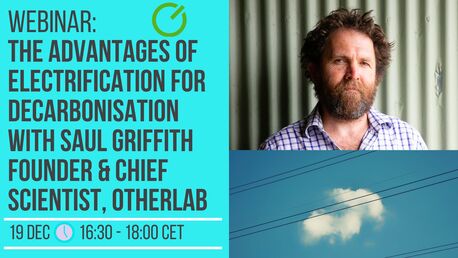
Some of the thought-provoking ideas Saul shares during the webinar are:
- High-resolution energy data across all sectors can provide new insight into decarbonisation.
- Efficiency is a false god leftover from the 1970’s narratives where the giant efficiency gain is in fact electrification.
- Electrification lowers the primary energy by more than half.
- A focus on electrification can bring positive conversations about transformation to stagnant climate debates.
- There is more storage than we believe in building systems and industry and we should have lower fears of renewable dispatch ability.
- We need to redesign grids to absorb all of these new assets, both generation, and storage.
- One can’t consider the generation side of electrification without also considering the demand side – a conversation too rarely had.
Agenda
Recording
Event Partners
This event was organised in cooperation with:

contact
Stephanie Bätjer
stephanie[at]renewables-grid.euDirector – Communication

Stephanie Bätjer
stephanie[at]renewables-grid.euDirector – Communication