
 2025
2025
 Ireland

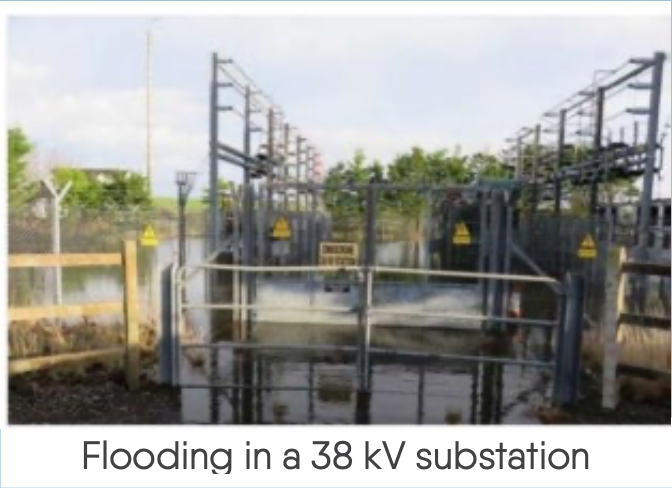
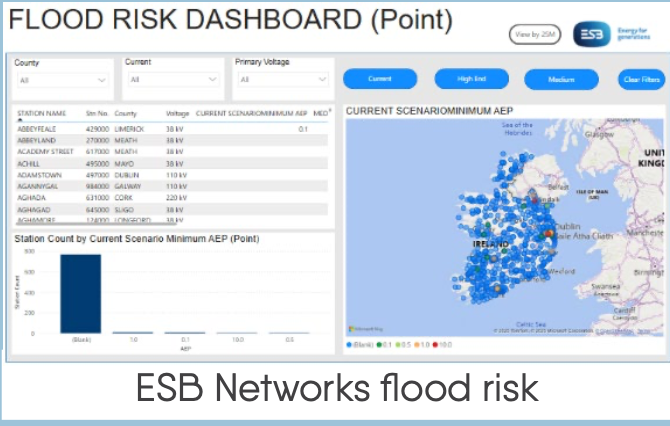
ESB Networks, the electricity distribution operator in Ireland, has developed a structured approach to mitigate flood risks for high-voltage (HV) substations. Using future climate projections (RCP 8.5 to 2050 and RCP 4.5 to 2100), the operator aims to enhance the resilience of substations against both pluvial (rain-induced) and fluvial (river-induced) flooding.
ESB’s approach includes three main steps: (a) identifying HV substations in flood-risks areas, (b) assessing the likelihood and extent of flooding, and (c) introducing short- and long-term mitigation measures. This systematic process helps ensure that substations remain operational and protected during extreme weather events, securing the stability of Ireland’s electricity supply.
Highlights
01
Uses national OPW flood mapping (CFRAMS- Catchment Flood Risk Assessment Management Studies and PFRA- Preliminary Flood Risk Assessment).
02
Combines GIS data with site inspections and local knowledge.
03
Includes both temporary flooding barriers and permanent flood defenses.
Main Information
Flooding poses one of the highest risks to Ireland’s electricity infrastructure. To address this, ESB Networks designed a national methodology for assessing and mitigating flood exposure across its substations network.
The process begins by identifying substations located within flood-prone zones using national datasets and mapping systems. Once high-risk sites are identified, engineers conduct detailed local assessments, examining topography, drainage capacity, and historic flood levels. The results inform the most suitable measures for each site, from elevating electrical equipment and sealing cable ducts, to building flood walls or adding drainage pumps.
Temporary and permanent measures are chosen depending on site conditions and urgency. For example, barriers may be installed for quick protection during flood alerts, while more extensive reconstruction is planned during refurbishment cycles. This approach has allowed ESB Networks to improve preparedness, minimise outage risks, and maintain energy reliability in a wetter, more unpredictable climate.
Links
For detailed insights on this practice, as well as other DSO initiatives, please refer to the full report available below. Additionally, visit the practice website for more information.


explore more practices