

On 10 December 2025, the European Commission published the European Grids Package, including a proposal for the revision of the Trans-European Networks for Energy (TEN-E) Regulation. RGI publishes an explainer addressing five important questions about this revision.
The revised TEN-E Regulation will have far-reaching implications for Europe’s electricity grid planning, governance and investment framework. The legislation is a key instrument for delivering on EU climate and energy targets and objectives, accelerating renewables integration, enabling direct electrification and deepening the internal energy market, thus, contributing to European resilience, competitiveness and affordability.
This explainer aims at enhancing clarity of key concepts in the European Grids Package, strengthening its implementability and contributing to its success. It addresses five key questions related to the revision of the TEN-E Regulation in the European Grids Package:
01
Why does the TEN-E Regulation matter?
02
What is the central scenario and what is it for?
03
Is a central policy scenario enough to plan the European energy system and guide investment decisions?
04
Who is involved in the system planning and how?
05
Going further: What does the proposal not yet fully address?
Read the full document
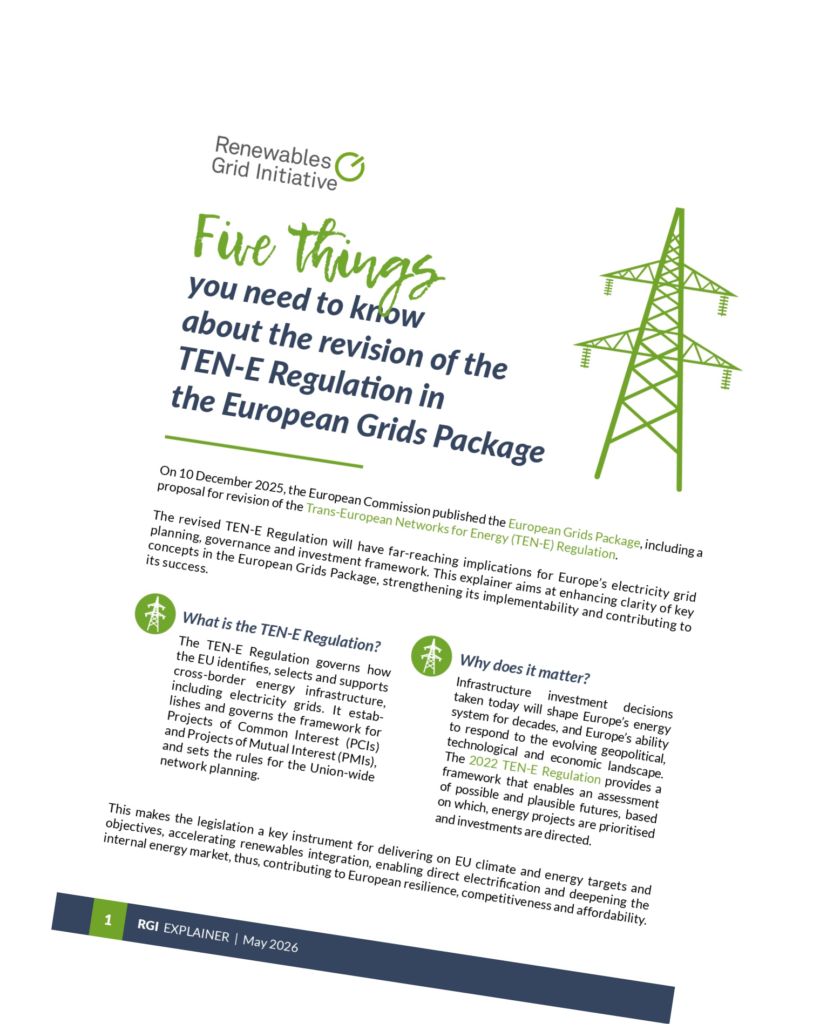
Explore the five key questions related to the revision of the TEN-E Regulation in the European Grids Package and find out why it matters in the bigger context. Explore the “In Focus” areas for more context knowledge.
contact
Alexandros Fakas Kakouris
alexandros[at]renewables-grid.euSenior Manager – Energy and Policy Systems

Dr. Andrzej Ceglarz
andrzej[at]renewables-grid.euDirector – Energy Systems

Alexandros Fakas Kakouris
alexandros[at]renewables-grid.euSenior Manager – Energy and Policy Systems
Dr. Andrzej Ceglarz
andrzej[at]renewables-grid.euDirector – Energy Systems