

Achieving international climate and energy goals will require a rapid and profound transformation of our energy system. Considering this process affects people all over the world, public engagement is crucial to ensure that society’s views, needs and concerns are considered and that a truly just and inclusive energy transition is pursued.
To facilitate this, the Engage4Energy Project focused on creating guidance on how public engagement can be promoted within the context of building renewable energy and grid infrastructure.
Over the past years and decades, many participation and involvement processes and practices have been developed, but no comprehensive overview of factors for success and failure exists. The project started filling this information gap by evaluating past and current participatory actions and drawing lessons for effective engagement, including useful formats and degrees of involvement.
The researchers behind this project provided transferable and actionable guidance for future engagement activities done by project developers and public authorities. Learn more about the project outcomes below.
Project partners and goals
RGI and the Institute for European Energy and Climate Policy (IEECP) led the project, funded by the User-Centred Energy Systems (UsersTCP) – part of the IEA Technology Collaboration Programme.


The project run from March 2023 to April 2024 and aimed at:
01
Identifying common challenges and drivers for effective public engagement on energy infrastructure.
02
Collecting evidence from international case studies about which public engagement approaches are effective or ineffective.
03
Developing a best practice guidance for public engagement around energy infrastructure.
Project implementation
Throughout the project, we involved stakeholders, specifically in the form of interviews and workshop participation. Based on their inputs, as well as a comprehensive literature analysis and the assessment of 98 cases, an interactive guide for meaningful engagement in energy infrastructure has been developed.
This will also lead to the provision of policy-relevant insights on effective engagement of the public in energy infrastructure developments – all with the overall aim of speeding up and improving public acceptance for the energy transition.
hIGHLIGHTED RESOURCE
E4E INTERACTIVE TOOL
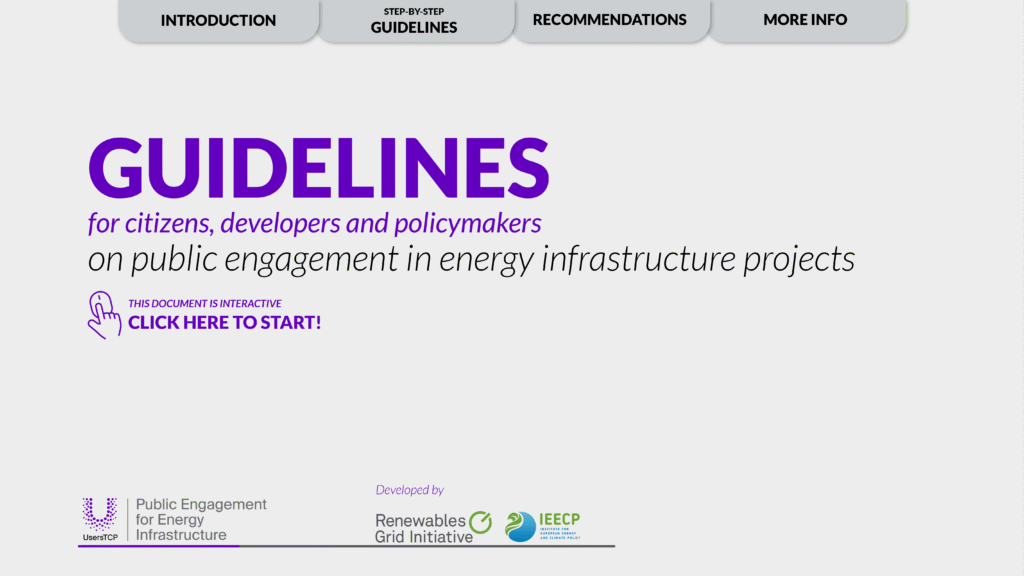
The Engage4Energy Guidelines for citizens, developers and policymakers on meaningful engagement in energy infrastructure projects have been launched based on RGI and IEECP’s year-long research
Publications & outcomes




contact
Dr. Andrzej Ceglarz
andrzej[at]renewables-grid.euDirector – Energy Systems

Nathália Pimentel
nathalia[at]renewables-grid.euManager – Communication & Energy Systems

Dr. Ira Shefer
ira[at]renewables-grid.euManager – Energy Systems

Dr. Andrzej Ceglarz
andrzej[at]renewables-grid.euDirector – Energy Systems
Nathália Pimentel
nathalia[at]renewables-grid.euManager – Communication & Energy Systems
Dr. Ira Shefer
ira[at]renewables-grid.euManager – Energy Systems