
 11 December 2025
 15:00 – 16:30
 Online
Organised by RGI & GINGR
The second session of Connecting Energies 2025 turned to the practical challenge of measuring biodiversity outcomes in energy infrastructure, showing how pollinators can reveal whether electricity corridors are truly Nature-Positive.
Connecting Pollinator Corridors
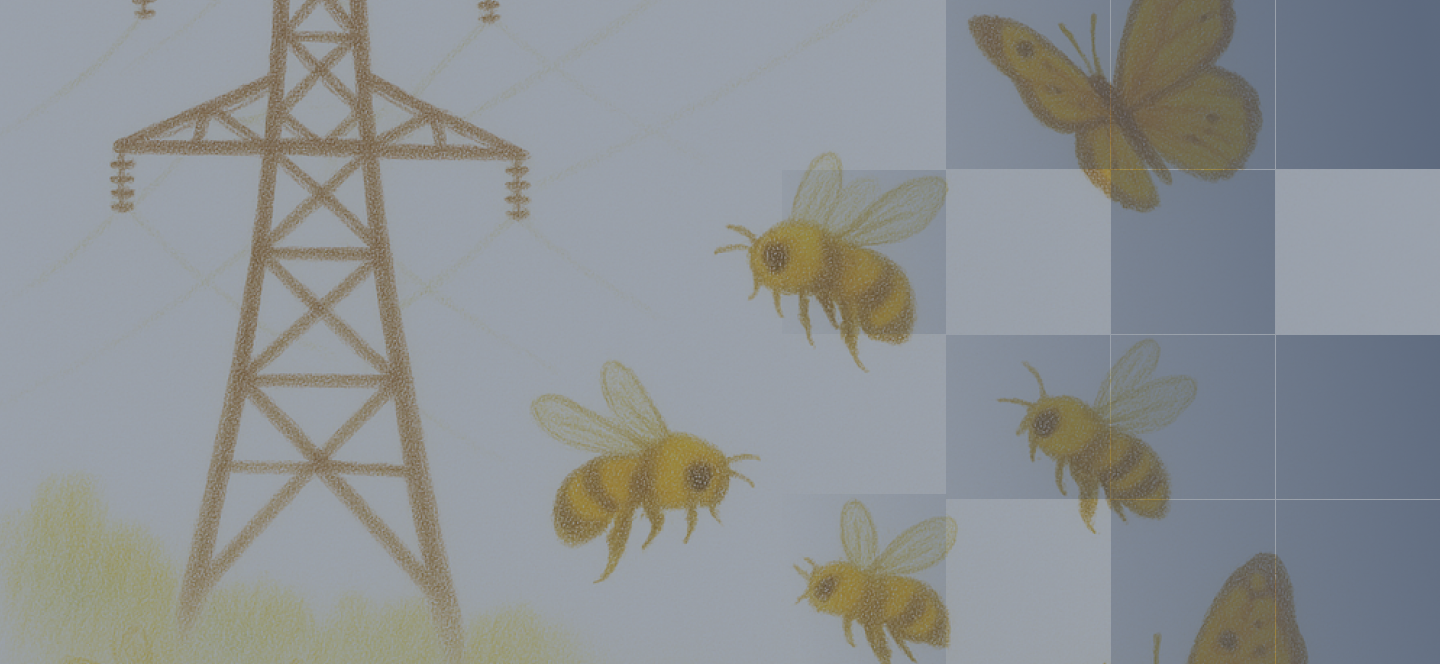
The second session of Connecting Energies 2025: Civil Society Webinar Series explored how electricity corridors can become ecological assets rather than interruptions in the landscape. When managed selectively, these spaces can support bees, butterflies and other pollinators that signal healthy ecosystems. The webinar focused on how evidence, drawn from field surveys, citizen science and satellite monitoring, can demonstrate measurable biodiversity gains in these linear habitats.
Participants learnt how Integrated Vegetation Management beneath power lines can create stable, flower-rich mosaics that enhance pollinator abundance and diversity while reducing maintenance demands. Building on this, the session introduced how Earth Observation tools can map habitat heterogeneity and floral resources, allowing the same ecological indicators to be tracked consistently across regions. These insights were then linked to governance frameworks that align ecological performance with asset management, policy disclosure and Nature-Positive reporting standards.
Speakers
- Dr Kimberly Russell – Associate Professor of Teaching at Rutgers University
- Kendall Jefferys – Postdoctoral Research Associate, University of Oxford
- Tiina Seppänen – Senior Expert, Land Use and Environment, Fingrid
- Adrián Maté – Environmental Coordinator – GINGR, RGI
- Annika Lilliestam – Coordinator – GINGR, RGI (Moderator)
Designed for civil society, the session translates technical methods into accessible language and practical steps. By connecting pollinator monitoring with global reporting initiatives such as natural capital accounting and the forthcoming GINGR Framework, it shows how credible evidence can shape infrastructure decisions, ensuring the energy transition benefits both biodiversity and communities.
Recording
Designed for civil society, the session translates technical methods into accessible language and practical steps. By connecting pollinator monitoring with global reporting initiatives such as natural capital accounting and the forthcoming GINGR Framework, it shows how credible evidence can shape infrastructure decisions, ensuring the energy transition benefits both biodiversity and communities.
Presentations


contact
Eston McKeague
eston[at]renewables-grid.euManager – Communication

Adrián Maté
adrian[at]renewables-grid.euEnvironmental Coordinator
Annika Lilliestam
annika[at]renewables-grid.euCoordinator – GINGR

Eston McKeague
eston[at]renewables-grid.euManager – Communication
Adrián Maté
adrian[at]renewables-grid.euEnvironmental Coordinator
Annika Lilliestam
annika[at]renewables-grid.euCoordinator – GINGR